Case 05 · Pearson · Athens / Global Learning Platform · 2016–2019
Making the problem-solving process visible
Context
Students needed guided practice and feedback on their reasoning. Instructors needed to see students’ work to understand where they struggled, while managing the demands of larger classes.
Executive summary
- Role
- UX Researcher and Research Lead
- Contribution
- Secured another two and a half weeks of research and coordinated research support across GLP teams.
- Scaffolding decision
- Break engineering problems into explicit steps rather than ask only for a final answer.
My research leadership described here is specific to Athens.
Research decision
Securing more research
After two research rounds, the team had identified promising features, but questions remained about their implementation. The original allocation covered only two rounds. I presented the remaining uncertainty, secured another two and a half weeks, and coordinated research support across GLP teams.
Product decision
The additional research informed a scaffolding decision: break engineering problems into explicit steps rather than ask only for a final answer. This made the problem-solving process visible and created opportunities for feedback along the way.
Product comparison
Making the steps visible
Restyled from original project materials.
The Athens screen is a prototype from the project materials, not a screenshot of the shipped product.
Earlier product experience
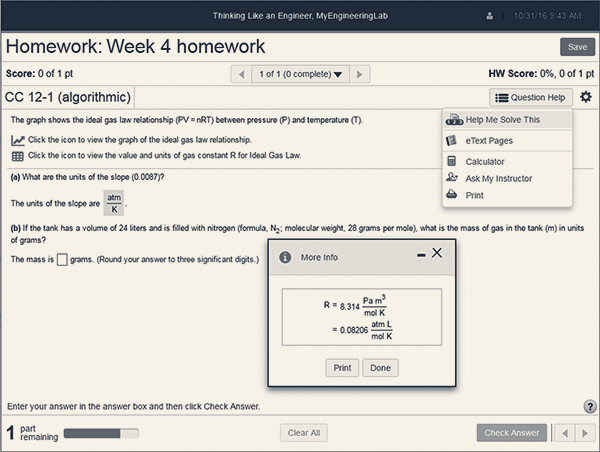
- Marker 1: Final-answer entry: a single answer box (“The mass is __ grams”).
- Marker 2: Correctness check: “Check Answer” after the answer is entered.
Athens prototype
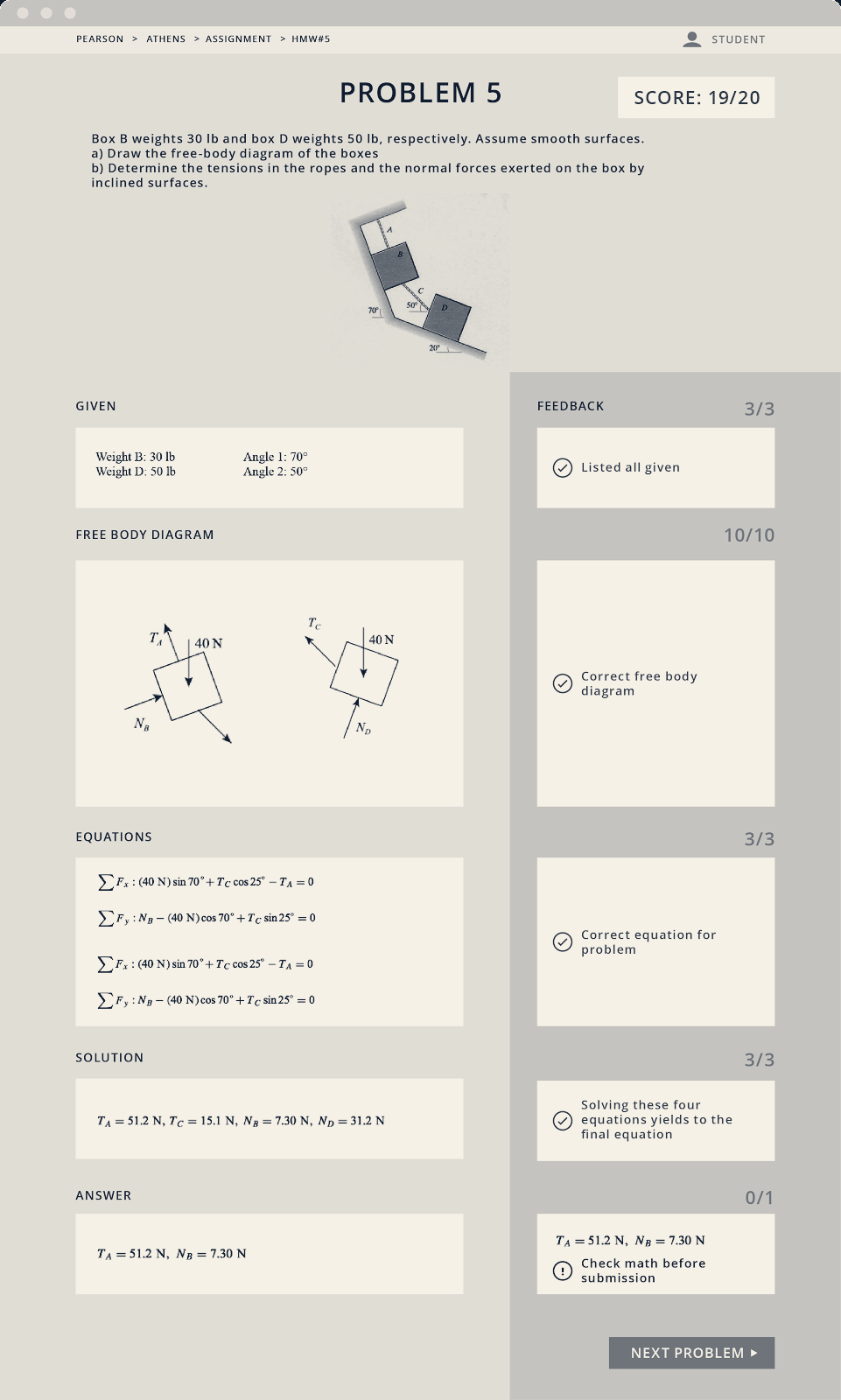
- Marker 1: Given — feedback: “Listed all given” (3/3).
- Marker 2: Free body diagram — feedback: “Correct free body diagram” (10/10).
- Marker 3: Equations — feedback: “Correct equation for problem” (3/3).
- Marker 4: Solution — feedback on the solution steps (3/3).
- Marker 5: Answer — feedback: “Check math before submission” (0/1).
Validation matrix
The feature-validation matrix documents testing across three rounds and MVP inclusion for stepwise practice, free-body diagramming, student feedback, and an equation editor.
Restyled from original project materials.
Stepwise Practice
Provide scaffolded practice with problem solving methodology based on common engineering practices that is customizable by instructors, so that students get the strong foundation they'll need to be successful engineers.
- Research Round: R1
- Tested and Validated
- Research Round: R2
- Fidelity of concept: Tested and Validated
- Research Round: R3
- N/A
- MVP
- Yes
Free-Body Diagramming
Simplified representations in a problem of an object (the body), and the force vectors acting on it.
- Research Round: R1
- Tested and Validated
- Research Round: R2
- Fidelity of concept: Tested and Validated
- Research Round: R3
- N/A
- MVP
- Yes
Student Feedback
When students get stuck on a problem or don't have the skills or concepts they need to complete a problem successfully, Athens will provide them with help and targeted remediation, including worked examples of similar problems, math and other prereq skills refreshers, and instructional content.
- Research Round: R1
- N/A
- Research Round: R2
- Tested and Validated
- Research Round: R3
- Fidelity of concept: Tested and Validated
- MVP
- Yes
Equation Editor
All assignment items must be graded instantly, consistently, and accurately, with data flowing immediately to the gradebook.
- Research Round: R1
- N/A
- Research Round: R2
- Tested and Validated
- Research Round: R3
- Fidelity of concept: Tested and Validated
- MVP
- Yes
Dashboard
Provide access to students' fully worked solutions, results and feedback for both instructors and students, so that they have a common, recorded view of each student's work to refer to throughout the course.
- Research Round: R1
- N/A
- Research Round: R2
- Tested and Validated
- Research Round: R3
- Fidelity of concept: Tested and Validated
- MVP
- Vector-based Palette for Version 1More robust solution for Version 2
| Feature | Research Round: R1 | Research Round: R2 | Research Round: R3 | MVP |
|---|---|---|---|---|
| Stepwise PracticeProvide scaffolded practice with problem solving methodology based on common engineering practices that is customizable by instructors, so that students get the strong foundation they'll need to be successful engineers. | Tested and Validated | Fidelity of concept: Tested and Validated | N/A | Yes |
| Free-Body DiagrammingSimplified representations in a problem of an object (the body), and the force vectors acting on it. | Tested and Validated | Fidelity of concept: Tested and Validated | N/A | Yes |
| Student FeedbackWhen students get stuck on a problem or don't have the skills or concepts they need to complete a problem successfully, Athens will provide them with help and targeted remediation, including worked examples of similar problems, math and other prereq skills refreshers, and instructional content. | N/A | Tested and Validated | Fidelity of concept: Tested and Validated | Yes |
| Equation EditorAll assignment items must be graded instantly, consistently, and accurately, with data flowing immediately to the gradebook. | N/A | Tested and Validated | Fidelity of concept: Tested and Validated | Yes |
| DashboardProvide access to students' fully worked solutions, results and feedback for both instructors and students, so that they have a common, recorded view of each student's work to refer to throughout the course. | N/A | Tested and Validated | Fidelity of concept: Tested and Validated | Vector-based Palette for Version 1More robust solution for Version 2 |
Research coordination
Alongside the product research, I created a shared research activity log to coordinate questions and priorities across Athens, Rio, and Oslo. It made overlapping research needs visible and supported cross-team coordination. Cost and time savings were not quantified.
Coordinating research across products
Restyled excerpt from original project materials.
Formatting simplified; wording and recorded priorities preserved. PMM expanded for clarity.
Workspace tabs in the source log
- Rio
- Oslo
- Athens (selected tab in the source)
- Research Schedule
- Research Strategy
- Agnostic Items
Athens is the selected tab in the source.
Priority columns
For the Product Marketing Manager (PMM) to determine: High, Medium, Low.
Topic · Dashboard
Research Question
What reporting and actionable insights of student performance do instructors value? What information would instructors want to track from the assignment?
Priority by round
- R1: Priority for Explore Phase
- Blank in source
- R2: Priority for Validate Phase
- High
- R3:
- Blank in source
- Alpha
- Blank in source
Project Significance
Do instructors want access to students' fully worked solutions, results and feedback for both, so that they have a common, recorded view of each student's work to refer to throughout the course?
Topic · Dashboard
Research Question
What actionable insights do students value in a dashboard?
Priority by round
- R1: Priority for Explore Phase
- Blank in source
- R2: Priority for Validate Phase
- High
- R3:
- Blank in source
- Alpha
- Blank in source
Project Significance
Do students want to see how many hints they used, what part of the problem solving process they scored well on vs. not as well, completion rates and scores?
Topic · Product Model Definition
Research Question
What is the minimum that this type of solution needs to deliver on, in order to make an impact on student understanding and execution of the problem solving process?
Priority by round
- R1: Priority for Explore Phase
- Blank in source
- R2: Priority for Validate Phase
- High
- R3:
- VERY HIGH
- Alpha
- Blank in source
Project Significance
MVP definition
| Topic | Research Question | R1: Priority for Explore Phase | R2: Priority for Validate Phase | R3: | Alpha | Project Significance |
|---|---|---|---|---|---|---|
| What is the question? | For the Product Marketing Manager (PMM) to determine: High, Medium, Low. | Why is this question important to the project? | ||||
| Dashboard | What reporting and actionable insights of student performance do instructors value? What information would instructors want to track from the assignment? | Blank | High | Blank | Blank | Do instructors want access to students' fully worked solutions, results and feedback for both, so that they have a common, recorded view of each student's work to refer to throughout the course? |
| Dashboard | What actionable insights do students value in a dashboard? | Blank | High | Blank | Blank | Do students want to see how many hints they used, what part of the problem solving process they scored well on vs. not as well, completion rates and scores? |
| Product Model Definition | What is the minimum that this type of solution needs to deliver on, in order to make an impact on student understanding and execution of the problem solving process? | Blank | High | VERY HIGH | Blank | MVP definition |
- Questions made explicit.
- Priorities recorded across research rounds.
- Product significance documented alongside each question.